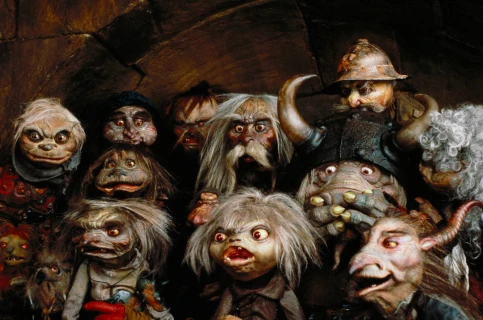
1. Don’t use goblins. If you need something in the genre of a speedbump, treadmill, or minor annoyance, don’t use goblins. Use something bizarre, uncanny, or otherwise out of the box. Something with unsettling orifices. Maybe something that requires research to establish what they want, how they reproduce, and/or how they can be killed. Alternatively, just use humans. Make them part of the world, plugged into the systems of politics and power, something that reveals more about the world and puts the players into motion with all these forces. Here’s 52 alternatives to goblins.
2. Goblins started out as troublesome, mischievous spirits in a world that was thought to be full of spirits, troublesome and benign. If that’s what you’re into, go all in with faerie, make your goblins part of the fae ecology. Start with Zzarchov Kowolski’s Gnomes of Levenec, then dig into Chris Tamm’s faerie idea emporium, including d100 goblin gifts, d100 goblin market stalls, and chambers amid the roots of the great tree.
3. USE GOBLINS. Goblins are ridiculous. Their plans are terrible. Everything they try and fix ends up worse. They are easily impressed by the most shallow and hackneyed markers of status. They are easily distracted, casually cruel, utterly lacking in self-awareness, and have horrible taste. In other words, they are just like us. Like, us, turned to 11, and without our surprising capacity for care, creativity, and grace. Goblins are a parody of humanity, revealing our hubris. What better monster could there be?
Goblins are never the ones behind the curtain. They are, like bureaucrats, the dubiously competent and sometimes deadly front line of larger powers and principalities. (Otherwise you're risking a nihilism which makes Cthuloid gods squares by comparison.)
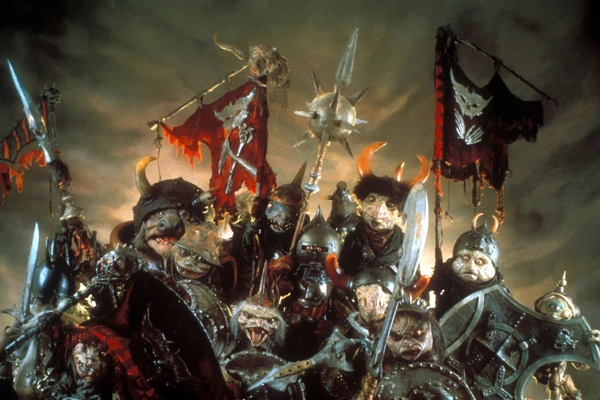
Goblin RPG Resources
1. Grant Howitt’s Goblin Quest. This is a glorious goblin game full of goblin sensibility, drawing on a broad range of creative powers to explore goblindom. It offers numerous prompts for collaborative goblin world-building and scheme-hatching. (You have to buy this, the rest of this list is free.)
2. Paizo’s Goblins. Paizo, or possibly Wayne Reynolds, managed to put their finger on something quintessentially goblin. Check out the compendium Goblins of Golarion, check out their free "We Be Goblins" adventures, and most of all check out Matt Mercer leading his crew through a goblin adventure, "To the Poop!"
3. Arnold K, unsurprisingly, has fantastic goblin ideas, including the iconic chart “WTF are those goblins doing?” (which also reminds us that randomly encountered enemies should probably be doing something), d8 shitty goblin weapons, and a couple of fabulous, filth-filled "yoblin" posts.
4. If you want a quick goblin adventure, and aren't running Goblin Manor, I recommend Dyson's Infinite Caves of the Shroom Goblins adventure.
5. Chris Tamm’s Elfmaids and Octopi has an embarrassment of goblin resources. For a firehose of ideas and inspiration, start with his goblin mines, then keep on digging through his many lists. I particularly like d100 Goblintown encounters and Goblin Gimmicks.
6. Ray Otus has created Goblintown, a goblin PC adventure system. It's much like Howitt's Goblin Quest, except more compact and freely available.
7. Logan Knight has a solid collection of goblin ideas.
8. The Furtive Goblin has a podcast exploring the historical provenance of goblins. It's very well-researched, and comes with a full transcription, check out the first episode. Hopefully we'll hear more soon!
9. James Maliszewski wrote a brief post for WoTC on the history of goblins in D&D.
10. GURPS Goblins - Written by Klaude Thomas and Malcolm Dale. It took me a bit to track this one down. GURPS Goblins gives a framework for adventures in late Georgian England if society was made of goblins. It has a framework for creating a "social web" as the real campaign map, a geography for the horrible schemes players (as goblins) pursue to "better" themselves. It is chock-full of horrible art and bits of goblin flavor. It's better than reading Henry Mayhew as a bestiary, as it recognizes the whole social edifice is goblin.
11. I humbly submit my own d100 goblins (including names, weapons, and annoying quirks), from the Goblin Manor adventure, currently available in playtest form (which you should definitely check out). For more inspiration, see my review of goblins in film and literature. In a future post, I will offer a more mechanically-oriented assortment of goblin foes and technology.
How I Describe Goblins
Goblins are corruption, decay, rot, and sour. They are twisted, if not the twist itself. They create nothing of their own, but are endlessly inventive in parody of other societies. This parody is ironic without bottom, there is neither love nor seriousness (although they may be kind in their weaker moments). Everything is a joke, including themselves. They are cowardly, but value life so little as to appear brave. Goblins take the self-conceit of civilization to its natural end, unconstrained by any higher purpose. They embody hypocrisy, bad ideas, and petty vices.
Goblins, unable to create, are more fungus than animal. They will occasionally play at being men or women, generally as a momentary joke or artless parody. They proliferate most where society is rotten and corrupt. They may not have always been thus. They are gleeful in wanton destruction, prideful of the most crass markers of status, and have a predilection for slavish obedience. At least until they get bored. They are easily distracted, but can muster surprising enthusiasm at a moment’s notice. As such, they are natural bureaucrats, foot soldiers, and yes men, except utterly incompetent in every role.
Goblins, unable to create, are more fungus than animal. They will occasionally play at being men or women, generally as a momentary joke or artless parody. They proliferate most where society is rotten and corrupt. They may not have always been thus. They are gleeful in wanton destruction, prideful of the most crass markers of status, and have a predilection for slavish obedience. At least until they get bored. They are easily distracted, but can muster surprising enthusiasm at a moment’s notice. As such, they are natural bureaucrats, foot soldiers, and yes men, except utterly incompetent in every role.

